Ten years of the Social & Labor Convergence Program
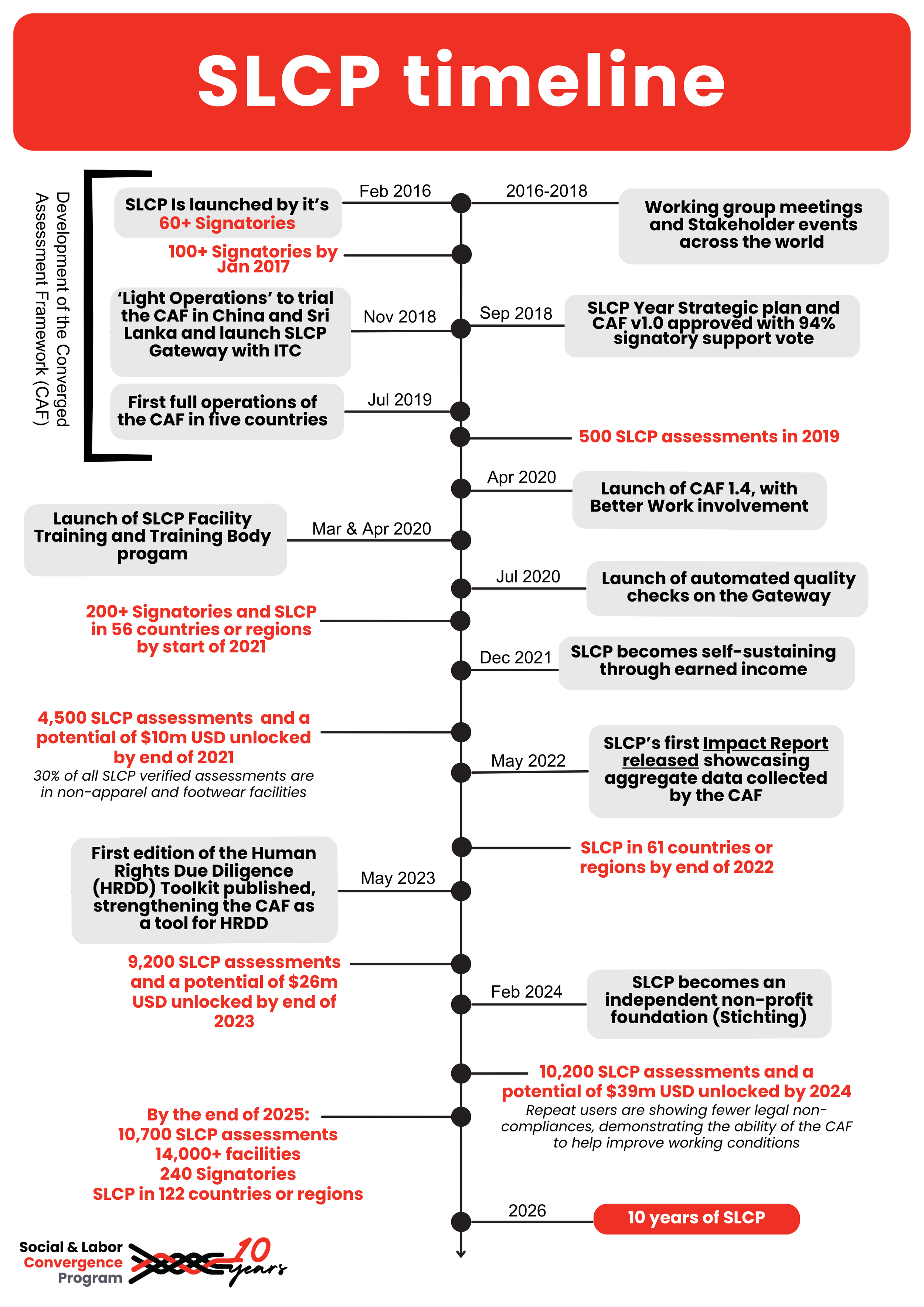
SLCP Timeline - 2016 to 2026
SLCP was created as a solution to a shared problem.
At the time, the manufacturing industry was characterised by duplicative social audits, growing audit fatigue, with limited comparability and trust in social assessment data, and a lack of ownership by facilities over their own data.
The Social and Labor Convergence Program (SLCP) set out with a clear and specific objective: to create a converged social assessment framework that would reduce audit duplication, provide credible and actionable data, and enable facilities to own and share their data with stakeholders.
Facilitated by Cascale (formerly the Sustainable Apparel Coalition), SLCP launched as a project in February 2016, beginning its journey to what now has become an independent multi-stakeholder initiative.
Collaboration is key to success.
The Converged Assessment Framework (CAF) was built collaboratively by SLCP’s Signatories, who grew rapidly in number in the development phase, from 33 in 2016 to more than 100 in 2019. With a diverse mix of brands, manufacturers, industry associations, audit firms, standard holders and civil society as Signatories, the process of developing a tool that met everyone’s needs was not a simple task – it required compromise, communication and trust.
By the end of 2018, the CAF v1.0 received an overwhelming vote of support from SLCP’s Signatories. We partnered with the International Trade Centre (ITC) and developed the data hosting and sharing model, with the SLCP Gateway as the central repository. The CAF and data system were then tested in China and Sri Lanka.
In July 2019, SLCP began operations as a Program, with the number of facilities and assessments growing year-on-year. We also established our first five-year strategic plan and a Council of elected stakeholder representatives to govern it.
We built a strong technical foundation, prioritizing usability and credibility to deliver a practical solution to duplicative social audits. Against the odds, SLCP has successfully moved from concept to development to implementation at scale, marked by increased adoption of the CAF and growing recognition of SLCP as a provider of a credible, actionable dataset.
One of the key factors to SLCP’s success was having a clear vision and mission that was anchored in collaboration. We understood that we were just one piece of the puzzle in reaching decent working conditions in global supply chains. We pro-actively collaborated with other organizations, including Worldly, ILO Better Work, the Better Buying Institute, Fair Wear and many others. By embedding a multi-stakeholder governance model, wehelp foster trust between the stakeholders who hold the pieces to the other parts of the puzzle.
Growing adoption leading to impact.
Ten years on, SLCP has delivered tangible impact. We have reduced duplication of social assessments, with the average SLCP assessment shared 2.96 times in 2024. This translates to a potential of $39 million USD unlocked for improvement actions. We now operate as an independent non-profit foundation based in the Netherlands, with over 240 Signatories and more than 14,400 facilities worldwide who use SLCP.
Along the way, we have learned and improved the consistency and comparability of social data by aligning the CAF dataset with International Labor Standards and Human Rights Due Diligence (HRDD) frameworks. We are making credible and actionable data available between a broad range of industry stakeholders to act upon, including governments and worker or employer organizations. We have enabled ownership and agency for facilities through our data sharing model, and have proven that genuine multi-stakeholder collaboration works.
But we’re not finished here – there is more to be done to achieve our goals.
With the upcoming release of CAF v2.0, we're making the tool more aligned with stakeholder needs, while ensuring simple, streamlined processes and systems. Through increased alignment with HRDD requirements, the new version of the CAF will also further support stakeholders to comply with emerging legislation. SLCP will also focus on building partnerships that support and facilitate remediation efforts, helping facilities address and improve working conditions more effectively.
The next chapter will determine whether the industry fully realises the benefits of convergence. Broader industry adoption is needed, with deeper SLCP integration across supply chains, and continued commitment from stakeholders. Emerging legislative requirements are further increasing the reporting burden on manufacturers and – without industry-wide collaboration – there is a significant risk of increased duplication. With workers also vulnerable to the increasing instability of global supply chains,, it is more important than ever to streamline data collection and to shift focus to impactful and lasting change to working conditions.
Engage with SLCP. Use and support the CAF. Contribute to a system that reduces audit fatigue while improving working conditions for global supply chains.